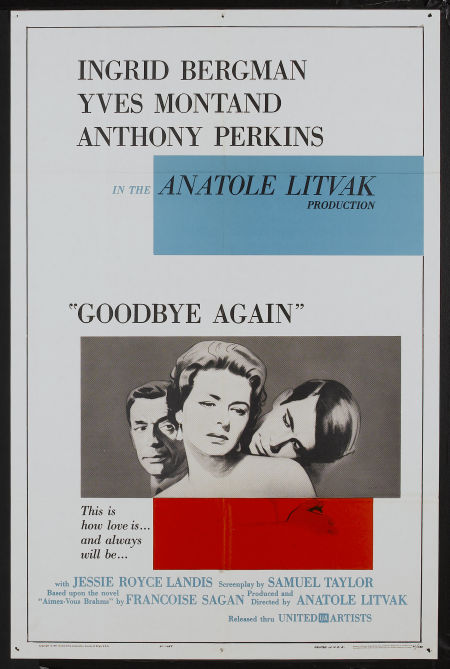
U.S. One Sheet Poster
Goodbye Again (aka Aimez-vous Brahms?, the name of the French novel on which the film is based), a drama directed by Anatole Litvak in black and white, is a French-U.S. co-production that was originally distributed by United Artists. Set in Paris, it tells the story of Paula Tessier (Ingrid Bergman), a divorced interior decorator, who has been dating businessman Roger Demarest (Yves Montand) for five years. Demarest professes that he cares for her deeply, but he also does not want to be married again. Paula, who is 40 (perhaps older), is starting to struggle with the lack of commitment from Roger and her own self-image and sexuality as she is approaching middle age.
Although Roger likes the stability of his uncommitted relationship with Paula, he also has an eye for younger women. One of those dalliances, all of whom he simply likes to call Maisie, is played by Jocelyn. He spots her dancing in a club, and he eventually makes a business trip excuse with Paula, so that he can taker her out of town for the weekend.
Meanwhile, Paula has a new, rich client, whose unmotivated and spoiled son, Philip (Anthony Perkins), takes a shine to her. In fact, he falls madly in love with her. He barely works at his legal job, mostly frittering away his days waiting on Paula to get off of work, so that he can pursue her. Paula resists his advances at first, but she begins to like the attention because of the seeming neglect by Roger. At first Roger is amused by Philip's antics and doesn't take it seriously, but eventually becomes jealous after Paula sleeps with Philip. This leads to a break-up between Paula and Roger, after which Philip essentially lives with Paula.
After months apart, Roger eventually professes his devotion to Paula, and they get married, breaking Philip's heart. Paula soon learns, however, that nothing has really changed.
Goodbye Again is generally a good movie. It is the most "high-brow" movie in which Jocelyn appeared. Bergman was considered by most to be a great actress, and she gives a strong performance here, as does Montand. The story is interesting, and the movie is generally well-done.
With all of that said, I do not consider it to be a great movie because of two problems. First, I think that the film is too long at 120 minutes. I believe that about 15-20 minutes of trimming could have improved it. Second, I do not like Anthony Perkins in the role of Philip. Philip is supposed to be immature, spoiled, and unmotivated, but Perkins manages to also emasculate the character and make him seem more like an unbalanced stalker. Beside the fact that the 45-year-old Bergman seems more like she should be his mother, it just seems implausible that she would fall into a relationship with someone as wimpy as him. Although I suppose that Paul Newman would have been a bit too old for the part (and perhaps too big of a star by that time), it occurred to me that someone like Paul Newman would have been better suited for the role of Philip.
As for Jocelyn, she was well-cast in her role as a young, impulsive woman out for a good time. She doesn't have a lot of screen time, but she has enough to be memorable and speaks her lines in unaccented English. If she hadn't already done enough to get noticed by producers in the U.S., this appearance should have done the trick. This is a film worth watching.
The film was shot in the fall of 1960 in France. The November 30, 1960 edition of Variety noted: "Goodbye Again" is the new title of Antole Litvak's
film version of Francoise Sagan's "Aimez Vous Brahms?" now being filmed
in Paris for United Artists release.
Filming was completed December 14, 1960 according to Variety. In May 1961, it was screened at the Cannes Film Festival. Perkins was awarded Best Actor honor at the festival for his performance as Philip (guess it's a good thing that I wasn't a judge). The film began its U.S. run in June 1961 and had good box office returns.
Goodbye Again was reviewed in the June 30, 1961 edition of Variety based on a viewing in New York (with a running time of 120 minutes), generally concluding that:
"In addition to guaranteeing a mint to United Artists, producer-director Anatole Litvak's 'Goodbye Again' serves another function: to prove that soap opera life can be literate, if not beautiful. The secret storm raging within heroine Ingrid Bergman is vintage formula stuff (which man will she choose?), but here it's told in comparatively adult, often witty terms. And, in the resolution of the triangle, there is a note of dispassionate irony that would do credit to sterner, more ambitious drama."
It went on to note that "The other performances seem either pale or overwrought alongside Miss Bergman's. Perkins, who won the top male acting prize at Cannes this year for 'Goodby,' is overdoing his 'coltishness' to the extent of being a self-parody, and Montand looks like a guy who has wandered into a ladies room by mistake. Jesse Royce Landis is amusing as Perkins' addlebrained mother, and Jackie Lane piquant as one of Montand's series of doxies."
Goodbye Again has received several home video releases in various countries through the years.
1993 U.S. VHS:

2009 Australian DVD:


German DVD:


Spanish DVD:


South Korean DVD:

Now, for some publicity material. The U.S. one sheet poster is shown at the top of this post. Here are the 40x60, half sheet, insert, and window card posters, as well as the lobby card set:


U.S. stills (the first 3 feature Jocelyn):


Soundtrack album:


U.S. paperback tie-in:


British lobby cards:


A French photo:

A German program and German press photos:


Spanish posters:
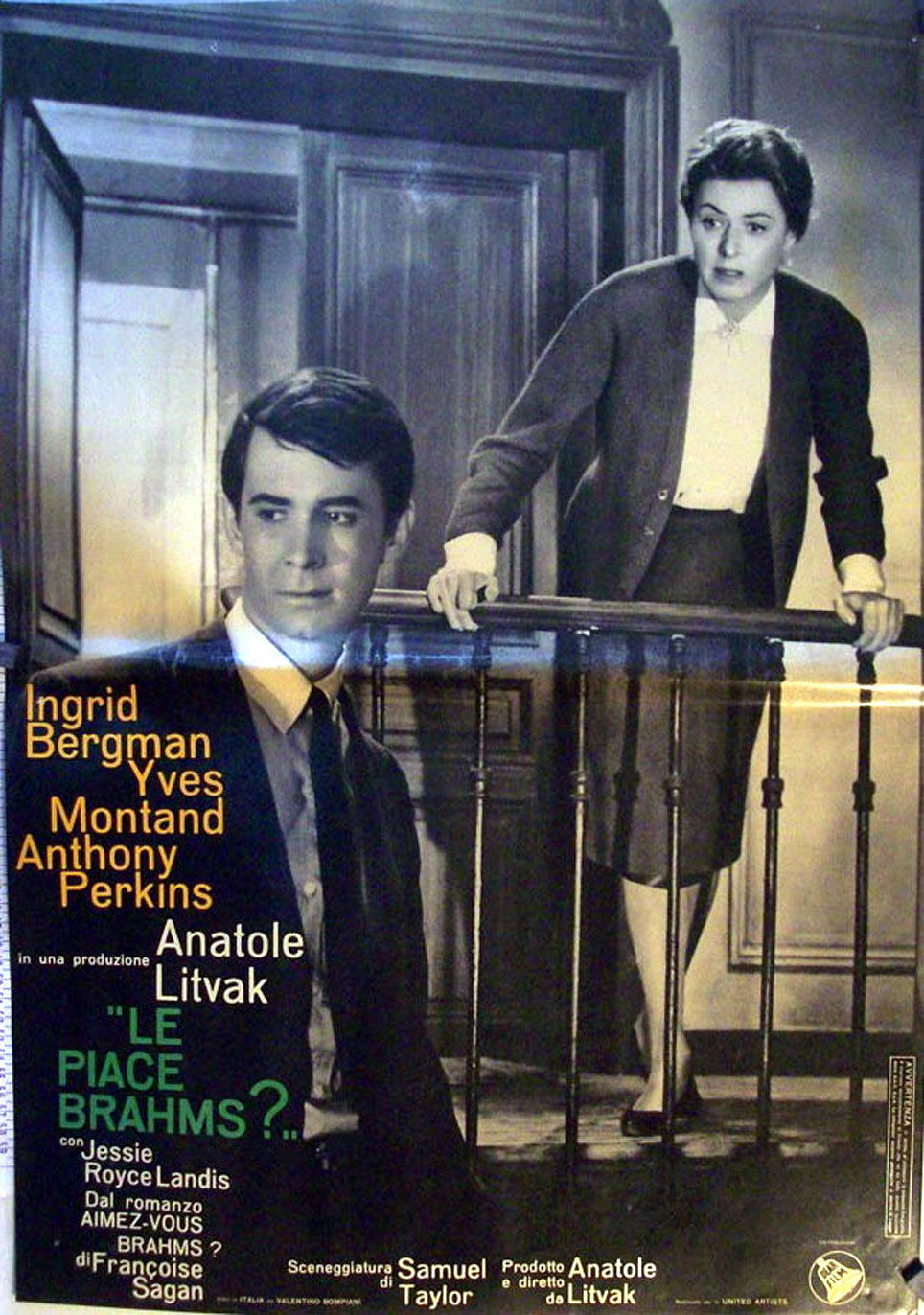

Romanian poster:

Yugoslavian poster:


